
The Driver, the Navigator, and the Backseater
How you position yourself relative to AI determines whether the journey ends where you intended.
There is a moment every driver knows. The road splits. The decision is yours. Someone in the seat beside you, or behind you, has an opinion. You take it in, you weigh it, and then you go left or right. Whatever happens next is on you.
That moment has not changed. What has changed is who, or what, is in the other seats.
What the machines have always done
Every industrial revolution has handed more execution to machines, but every previous one has kept accountability with humans. That pattern has held across two centuries and four distinct waves of change, and it is worth understanding why, because the fourth wave is the first to seriously test it.
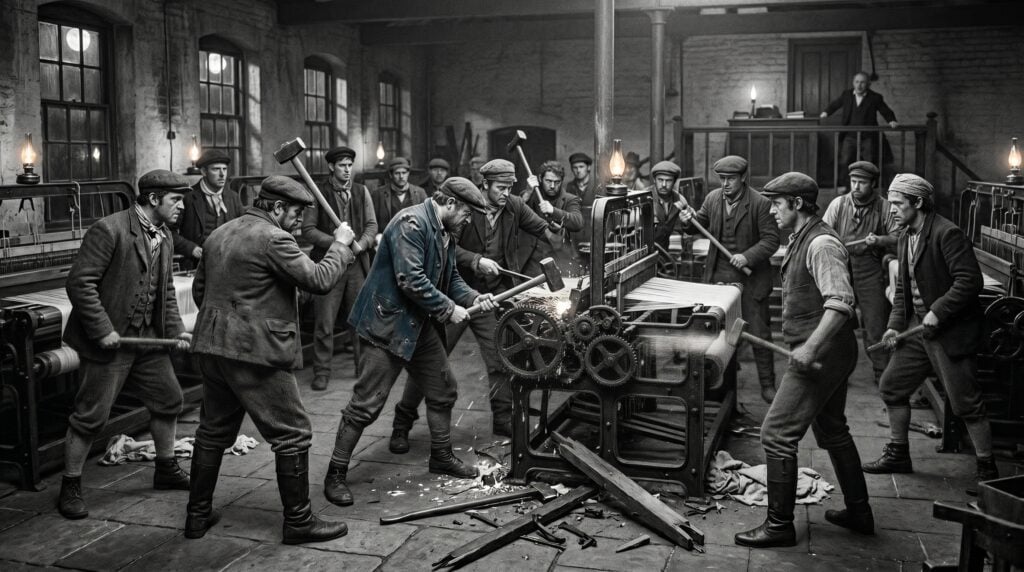
In 1811, a group of English textile workers began destroying machinery in the mills of Nottinghamshire. They were skilled craftspeople: weavers, knitters, trained artisans who had spent years mastering a craft and watched power looms start doing it faster and cheaper. Their movement, named after the mythical “General Ned Ludd,” spread across Yorkshire and Lancashire, drew 14,000 government troops to suppress it, and ended with public hangings and deportations to Australia (Historic UK, 2018; WEF, 2014). They were not wrong that their livelihoods would be disrupted. They were wrong only about the outcome. The textile industry grew. The economy that surrounded it grew faster. The jobs that disappeared were replaced by entirely new categories of work that could not have existed without the machines. Handloom weavers lost their specific occupation, but factory supervisors, engineers, mechanics, and managers gained theirs. Every one of those new roles kept accountability with a human being.
The pattern repeated across the following two revolutions. Electricity and mass production. Computers entering white-collar work. Each time, the same fear: would this wave be the one that made human labour dispensable? Each time, the same structural result. MIT economist David Autor’s foundational 2015 paper in the Journal of Economic Perspectives documented it precisely: automation replaces labour in specific tasks while simultaneously creating new demand in adjacent and new roles, raising output and lifting wages in the process. “Journalists and even expert commentators,” Autor wrote, “tend to overstate the extent of machine substitution for human labor and ignore the strong complementarities between automation and labor that increase productivity, raise earnings, and augment demand for labor.” The machine took the execution. The human retained the judgment and the accountability.
The fourth revolution, the one we are inside today, is genuinely different from the first three in one specific way. It is the first time machines have produced output that looks like reasoning. A steam engine could power a loom, but could not draft a contract. A computer could run a spreadsheet but could not hold a conversation, synthesise context from scattered information, or generate a plausible answer to a question it had never directly encountered. Large language models do all of that: they identify patterns across extraordinary volumes of training data and generate statistically plausible responses, with no underlying reasoning from principles. The output arrives with the fluency and confidence that, historically, meant a human had thought carefully.
The complexity of what machines now perform has changed beyond anything the previous three revolutions attempted. The underlying nature has not changed. But the gap between the surface and the substance is wide enough to be dangerous.
The Driver, the Navigator, and the Backseater
Every business is a vehicle moving through terrain it does not control. Market conditions shift. Competitors change tactics. Customers change what they want. Regulation moves without warning. Within any vehicle, three distinct roles carry very different levels of vision, influence, and consequence.
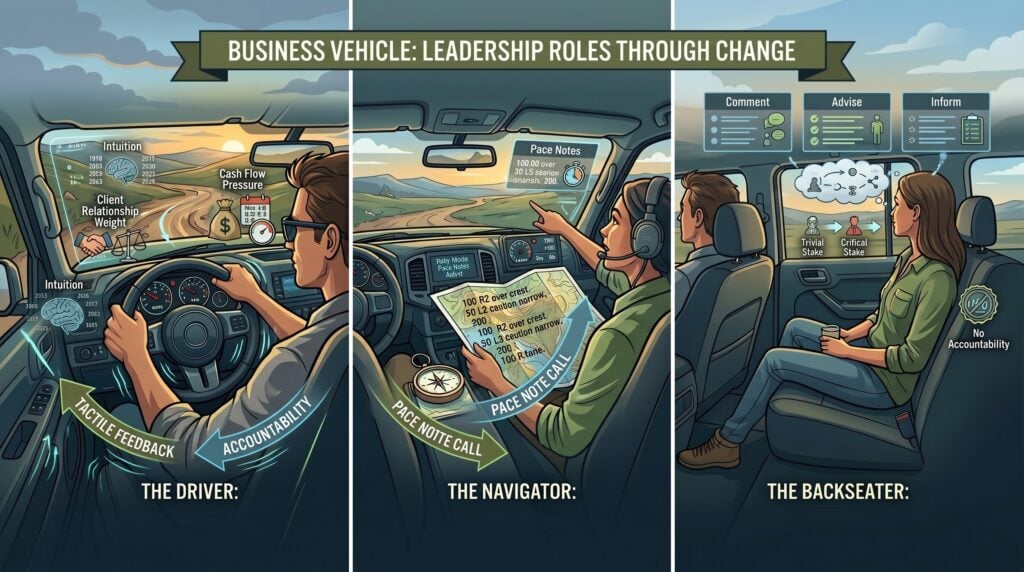
The driver holds the wheel. They feel the road through the seat: the surface changes, the pull on a corner, the vibration that arrives a second before anything visible happens. What they cannot see ahead, they often feel before it arrives, through the weight of a long client relationship, the pressure of a specific week’s cash flow, the intuition built from years in this particular vehicle on these particular roads. When the vehicle goes somewhere it should not go, the driver answers for it. The driver’s accountability is structural; it cannot be handed off to the navigator, the backseater, or the vehicle itself. Every significant decision requires the driver’s commitment. No one else in the vehicle can make it on their behalf.
The navigator sits in the front but does not touch the wheel. In professional rally driving, the navigator reads pace notes: a detailed account of every corner, every surface change, every hazard ahead, written during a reconnaissance run before the race begins. The driver cannot see a sharp right turn until they are metres from it. The navigator says “sharp right, caution, narrow” while there is still road to respond. They have access to instruments, timing information, and foresight that the driver simply does not have from behind the wheel. Their influence is real, binding, and immediate, but their authority is not, as the driver can always ignore the call and follow their own instincts or standpoint.
The backseater has the widest field of thought and the narrowest field of vision. Side windows only, a general sense of direction and movement, and the passing world. They have space: more room than either front seat to think broadly, to make connections the front occupants are too focused to notice, to hold a longer view while the driver manages the immediate road. Their suggestions arrive at the same confidence whether the stakes are trivial or critical; they have no way to calibrate otherwise, because they cannot feel the vehicle’s speed. The term is not accidental. A backseater, in everyday language, is someone who gives opinions without much accountability. They comment, they advise, they inform, but they do not act.
You are the driver. AI assistants are backseaters.
Most business owners have at least tried a generative AI tool. A significant and growing share use one regularly. The Goldman Sachs 2026 survey of small businesses found that 67% of small business owners expect AI to increase their revenue. A majority are already experimenting across their operations.
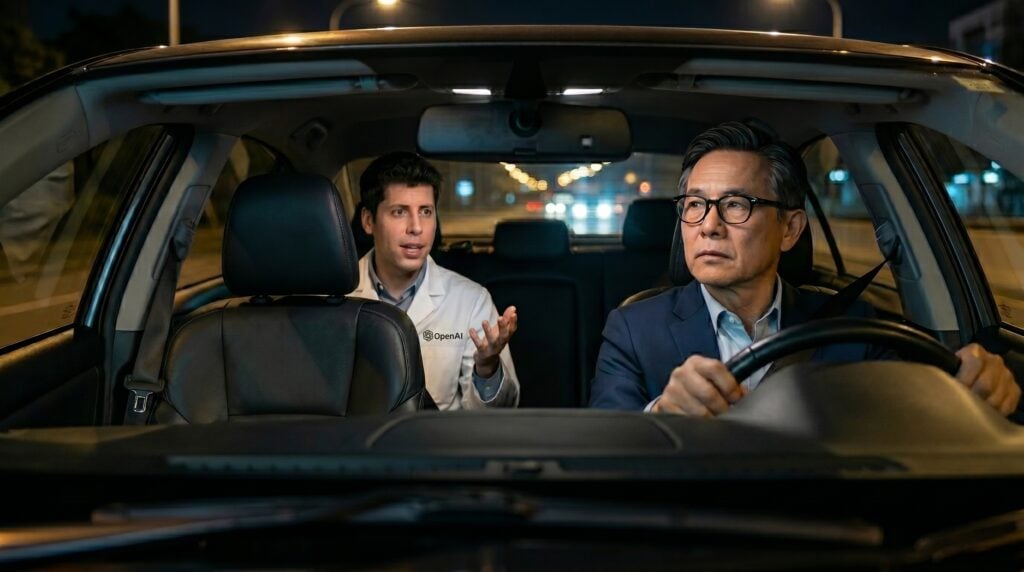
An AI assistant, in the form most people currently use it, is a backseater. ChatGPT, Gemini, Claude, and their equivalents are trained on vast general data with no knowledge of your business, your clients, your current pipeline, or the pressure of this week. They comment, advise, and generate. They do not know which decision matters most right now, and they produce output at the same confidence level whether the stakes are trivial or serious. A hallucinated fact arrives in exactly the same fluent, assured prose as a correct one. In 2023, two US attorneys discovered what this means in practice when they submitted a legal brief citing six cases that did not exist, all fabricated by ChatGPT, all submitted without verification. Air Canada found out through a court order, after its own AI chatbot gave a customer incorrect refund information and the airline was ordered to honour it. The AI bore no consequence. The driver always did.
The backseater is genuinely valuable from that position. The limitation is positional, not a flaw in the technology itself.
A dentist who uses an AI assistant to draft patient recall messages, summarise clinical notes, or generate options for a new patient welcome experience is putting a capable resource exactly where it belongs. The driver makes the clinical decisions. The backseater drafts, summarises, and generates material for the driver to assess and use. A personal trainer who uses AI to draft client progress emails, brainstorm programme variations, or generate re-engagement copy for a newsletter is doing the same. The client relationship is built by the trainer. The AI provides material to work from.
A builder who uses AI to draft a quote narrative, a real estate agent who uses it to write a property description, an accountant who uses it to produce a first pass at a client report: these are all backseater configurations. The professional shapes and owns the output. The AI provides the raw material quickly.
When AI moves to the navigator’s seat
A backseater responds when asked. A navigator acts without waiting for the question, because it has been given a map of the road and trained to read what the driver cannot yet see.
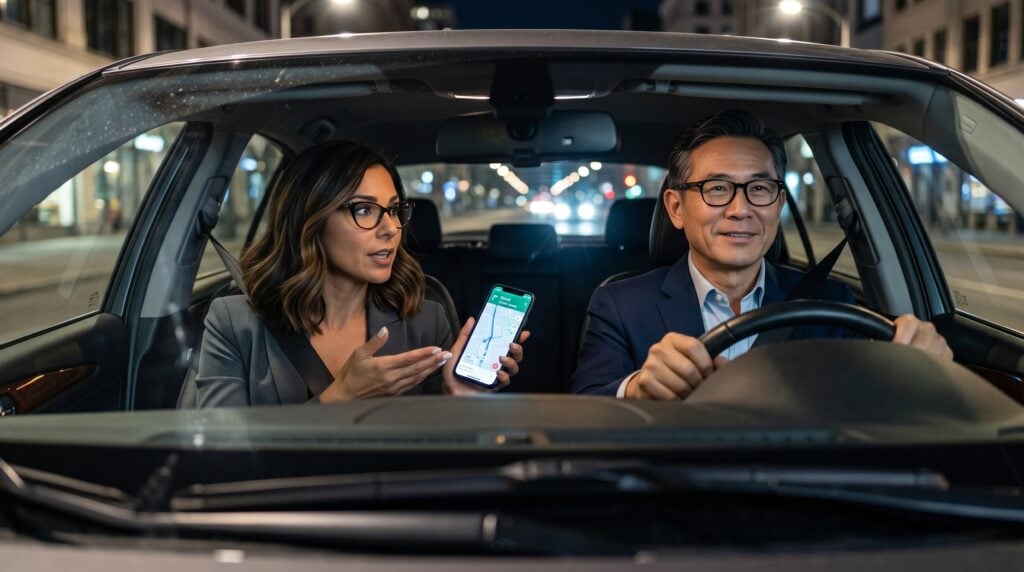
The shift happens when AI is given not just a task but a process: a defined route, a set of conditions to watch, and the ability to act within those conditions before the driver notices a problem. This is the monitoring and automation layer. It changes the AI from a reactive resource into a proactive one, and it changes the driver’s experience from managing tasks to managing outcomes.
A dental practice whose system monitors the appointment pipeline and flags recall patients who are overdue before the month-end gap becomes visible has a navigator. A real estate agency whose system tracks lead response times, identifies enquiries that have gone cold beyond a defined threshold, and triggers a follow-up before the lead calls a competitor has a navigator. A personal training studio whose system watches member visit frequency, identifies clients who are dropping off before they cancel, and sends a re-engagement message at the right moment has a navigator.
In each of these cases, the navigator does not need to be AI. A skilled operations manager, a well-trained receptionist with a good system, or an attentive practice coordinator can all fill this role. AI enhances the navigator’s capacity considerably: it can watch more signals simultaneously, apply rules consistently across larger volumes, and operate without the gaps that come with human schedules. But the navigator function itself, reading the road ahead and directing the driver’s attention to what is coming, is a human concept that AI extends rather than invents.

This configuration often includes a person. An employee who manages a configured AI system, setting the parameters, monitoring the outputs, adjusting the rules, and escalating to the driver when something falls outside the defined path, occupies the navigator’s seat alongside the tool. When both seats are working together, the driver receives not raw data but a processed, prioritised signal: act here, now, for this reason.
Goldman Sachs surveyed 1,256 small business owners in early 2026 and found that 76% already use AI in some form, with 93% reporting a positive impact. On the other hand, only 14% have fully integrated AI into their core operations. Seventy-three percent say they need more training and resources to implement it properly. Basically, the overwhelming majority or businesses are driving with a backseat AI assistant. A small minority have a navigator. Fewer still have handed the wheel to an AI driver for any part of the journey. The Federal Reserve’s small business reporting from the same period found a similar split, with only 7% of AI-using firms describing the technology as fully integrated into how the business actually runs. The bottleneck is not access to tools. It is the operational depth to move AI from a seat in the back to a seat at the front.
When AI takes the driver’s seat
A generative AI assistant drafts a quote. A configured AI system monitors your pipeline. An AI voice agent answers every incoming call, handles every booking, and manages every rescheduling, regardless of the hour.

An AI that answers calls is always a driver because it acts directly in the world on the business’s behalf. There might not even be a human in the loop at the moment the call is received, the decision made, and the response given. Whether that happens 24 hours a day or only after 6 pm on weekdays, the AI is in the driver’s seat for every call it handles. Time-boxing an AI driver is a valid form of control. It is one of the guardrails that keep the configuration safe. But it does not change which seat the AI is sitting in.
In these configurations, the human moves to the navigator’s seat. They define the route before the race begins. They set the parameters. They monitor the outputs. And they retain the ability to intervene.
An AI driver that is performing well is easy to trust and easy to stop watching. That drift is exactly where things go wrong. Think of the driving school vehicle with dual controls. The passenger is no longer a navigator or a backseater. They become the instructor, as they don’t simply sit alongside the driver (now the student) and hope. They have a brake pedal that works independently of whatever the student does. The student’s confidence is irrelevant to whether the instructor can stop the car. Governance for an AI driver needs to be built on the same principle: the capacity to intervene is built into the architecture of the vehicle, not described in a policy document somewhere.

For a small business deploying an AI voice agent, a booking system, or any autonomous process, the practical guardrails break down into five areas, drawn from current governance frameworks published by NIST, the OECD, and Singapore’s IMDA:
- Scope and permissions. The agent is authorised to do specific things and nothing beyond them. An AI voice agent that books appointments should not be able to access patient records, change pricing, or send communications outside a defined template. Define the permitted actions before deployment and review them regularly.
- Escalation paths. Define in advance which interactions the AI cannot handle and what happens when it reaches them. The anxious patient, the complaint, the request that falls outside the script: these need a clear, tested route to a human, not a dead end or a generic response.
- Real-time monitoring. A dashboard, an alert, or a regular review of what the AI is actually doing. Compliance is encoded when every action is signed and traceable. Without visibility into agent behaviour, the navigator cannot read the road.
- Audit logs. A record of what the agent said, what decision it made, and when. If something goes wrong and a client or regulator asks what happened, the navigator needs to be able to answer. Logs also show drift over time: an agent that starts handling enquiries differently from how it was configured.
- A kill switch you have tested. Not a policy. Not a support ticket. A mechanism you have actually used, in a test environment, to stop the agent. Know what happens when you turn it off. Know what happens to interactions that are mid-flight when you do.
The Australian Government’s December 2025 policy on responsible AI use and the OECD’s 2026 framework on agentic AI both require that human oversight reflect actual intervention capability. Stating the intention to act is insufficient; the mechanism to act must exist and be tested. UNESCO’s Recommendation on the Ethics of AI, adopted by 193 member states, states that AI systems must not displace ultimate human responsibility and accountability even when operating autonomously. The navigator who has built these five controls into their vehicle is not just compliant. They are the one who can actually stop the car.
The receptionist and the roles closest to the edge
The previous sections describe a spectrum: AI as backseater, navigator, or driver, each a legitimate configuration with different levels of human control. That spectrum looks different depending on what the human was doing before the AI arrived.
For most professionals, the transformation argument holds comfortably. A dentist, a plumber, a personal trainer, or a real estate agent can deploy AI across all three configurations without any of those configurations threatening the core of what they do. The clinical judgement, the on-site skill, the client relationship, the negotiation: these remain with the human. The ILO’s 2025 Generative AI and Jobs index, mapping 29,753 tasks across 436 occupations, placed trades and professional services among the lowest AI-exposure categories precisely because the tasks at the centre of these roles have no viable automated substitute.
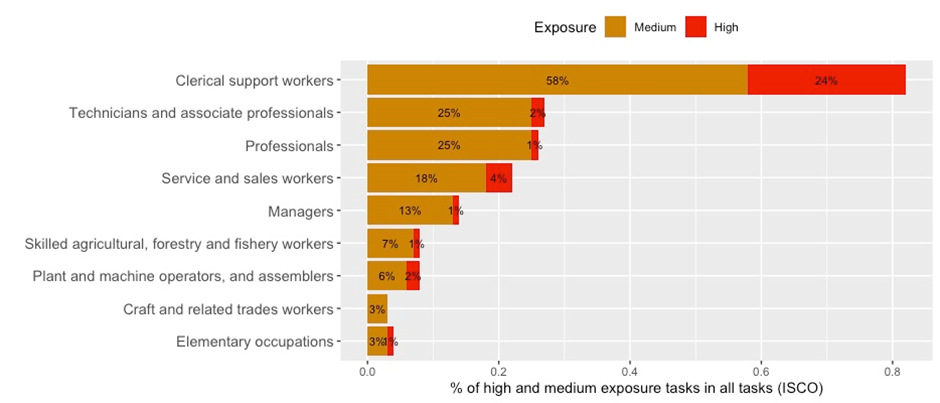
The roles that sit closest to the edge are those where the majority of daily tasks are structured, bounded, and repeatable. The ILO’s 2025 index identifies these as data entry clerks, payroll and bookkeeping clerks, typists and word processors, administrative secretaries, and general clerical workers. For these roles, the “transformation not replacement” claim requires more honesty. The ILO’s own conclusion is careful: even these roles are unlikely to disappear entirely, but warns that partial automation will “reduce job quality, shrink responsibilities, and create insecurity” for workers who remain in them as currently constructed.
The phone receptionist sits near the top of that list. A Pearson Skills Outlook study found that 42% of a medical receptionist’s working hours consist of tasks that generative AI can now perform: handling enquiries, scheduling appointments, confirming bookings, and directing calls. Forrester projected 100,000 contact centre agents displaced in 2025 alone, driven by AI handling routine, structured queries.
A business can use an AI receptionist badly. It can strip out the human role, force awkward customer interactions through a system that is poorly trained, and remove judgment where it still matters. But a business can also use an AI receptionist well. It can use AI to absorb peak-hour pressure or cover after-hours traffic. It can take outbound confirmation calls off a receptionist’s plate or it can qualify simple enquiries before they hit the team. It can route straightforward work away from humans so humans can spend their time on the calls that actually need tact, context, reassurance, or judgment.
That is why the receptionist example matters so much for SME owners. It shows both futures at once. One future turns AI into a blunt labour-cutting tool. The other turns AI into a constrained driver on safer roads, with clear rules, clean escalation, and humans concentrated where they add the most value. In that second model, the receptionist does not vanish by definition. The role changes shape. Less repetition. Fewer interruptions. More exception handling. More advanced enquiries. More patient or client care. More of the work that actually benefits from a person being present.
This is also where BEAI Expert belongs inside the argument, not outside it. If a clinic, agency, restaurant, fitness studio, salon, or trade business wants AI to drive part of the front desk safely, the work is not only about conversation quality. It is about fit: what the AI should handle, what it should escalate, when it should transfer, how it should log context, and how the rest of the team should work around it.
Watch our fictional character Martha doing the right thing in this and this campaigns. 
The creative road
Not every vehicle travels the same kind of road. A dental practice and a sound production studio are both businesses, both vehicles, both in need of a driver. The roads they travel are different enough to change how useful a backseater is.
On the creative road, there is more deliberate uncertainty. A producer choosing a direction for an album, a designer working through visual options for a client, an editor deciding on the structure of a piece: these decisions are not reducible to rules and patterns. They require judgment that is built from experience and taste, and they are the core of the work, not the surrounding administration.
This is where the backseater’s generative breadth becomes directly useful to the driver rather than incidentally useful to the administration around them. A driver asking the backseater to generate thirty stem variations before choosing a direction is not giving up the wheel. They are using the backseater for exactly what a backseater does well: producing a wide field of options at speed, without the cost of working through each one manually. The driver listens, assesses, and decides. The backseater has no opinion about which option is right. That is the driver’s call.
The risk on the creative road is the same pattern that operates in every vehicle. When the backseater consistently produces plausible output, the driver’s critical faculty relaxes gradually and without announcement. A producer who stopped questioning whether the reference is genuinely right because it sounds fine. A designer who stopped pushing because the first pass cleared a review. The feel for when something is genuinely right, as distinct from merely plausible, is a skill that erodes with disuse. That feel is the driver’s most important instrument on a creative road.
Slipping into the back without noticing
The driver does not always choose to move. Sometimes they drift.
A 2023 peer-reviewed study at Aalto University, published in the Journal of the Association for Information Systems, tracked an accounting firm’s use of automation software over several years. Skill erosion through over-reliance on automation occurred below conscious awareness, “acknowledged by neither workers nor managers,” until the moment a task requiring the underlying judgement was encountered and the skill was no longer there. The cycle is self-reinforcing: automation increases efficiency, which reduces the perceived need to maintain the underlying skill, which increases reliance on automation, which further erodes the skill. Nobody announces the transition. It happens between the lines of normal work.
A 2024 peer-reviewed study by Macnamara et al., published in Cognitive Research: Principles and Implications (Springer), found that participants continued relying on AI tools even when those tools were producing wrong outputs, without conscious awareness. At roughly 70% AI accuracy under high-workload conditions, humans still deferred. The backseater was giving wrong directions and the driver had stopped checking.
The same David Autor mentioned at the beginning, co-authored (sorry for the non-intended pun) another article: 2024 work on automation and expertise. They found that when automation removes routine tasks from a role, the work that remains typically requires more expertise, making the role more valuable. When automation removes the expert tasks, the role can be performed by less experienced people, compressing the premium that experience used to command. A business owner who consistently lets the backseater handle the most skilled calls in their practice is deciding their own professional value, possibly without realising that is what is happening.
Accountability does not travel with the output. It stays with the business owner, regardless of which seat they were sitting in when the output was produced. Which seat are you in right now, and did you choose it?
BEAI Expert builds and configures AI systems for business owners: voice agents, booking automation, lead nurture, and review management. If you want to talk about which configuration suits your vehicle, Sam is always available.
beai.expert | info@beai.expert | +61 468 052 425
Comments (0)
Be the first to leave a comment.